Automotive sealing systems are moving beyond traditional vulcanised rubber as manufacturers look for materials that combine elastic recovery, processability, recyclability, and consistent dimensional behavior. TPE and TPV compounds can provide rubber-like flexibility while remaining thermoplastic during processing, opening different possibilities for door seals, gaskets, damping elements, and other vehicle components.
A twin screw extruder gives compound developers a flexible platform for blending polymers, elastomer phases, fillers, stabilisers, and processing additives, while DEKUMA develops extrusion equipment for demanding polymer-processing applications.
Why TPE and TPV Change the Material Strategy
TPE and TPV are not simply direct substitutes for every rubber component. Their molecular structures and processing behavior differ from conventional vulcanised elastomers, so engineers first need to identify which performance characteristics the replacement part actually requires. Compression set, elasticity, hardness, abrasion resistance, temperature exposure, chemical contact, and dimensional recovery can all influence the formulation.
TPE generally describes a broad family of thermoplastic elastomers, while TPV typically combines a thermoplastic phase with a dynamically vulcanised rubber phase. The latter structure can provide a useful balance between elastic behavior and thermoplastic processing. Different grades can consequently be tailored toward sealing, flexible profiles, vibration control, or other automotive applications.
Part geometry matters just as much as material selection. A door seal may require repeated compression and recovery, whereas a gasket could face sustained contact pressure and exposure to fluids. Damping components introduce another set of requirements because energy dissipation and dynamic mechanical behavior become important. Conversion projects work best when the material is developed around the actual service environment rather than around a generic rubber replacement concept.
How Compounding Builds Application-Specific Properties
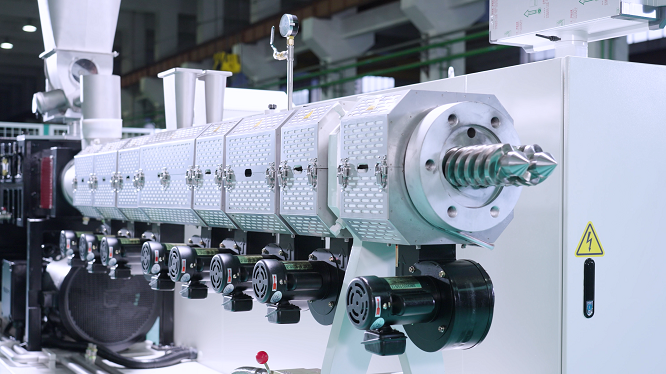
A twin screw extruder machine allows multiple ingredients to be introduced and mixed through controlled processing zones. Polymer feed, elastomer content, fillers, stabilisers, pigments, and other additives can be handled according to the formulation sequence. Screw configuration, temperature profile, residence time, and rotational speed then influence the degree of dispersion and the thermal history experienced by the compound.
TPV development can be particularly sensitive because the rubber phase is dynamically vulcanised during processing. The mixing environment has to support the intended morphology while maintaining a workable melt. Excessive heat or unsuitable shear conditions may alter the balance between the phases, whereas inadequate mixing can produce inconsistent compound structure.
Formulation trials also reveal why a single processing recipe rarely suits every automotive elastomer. Increasing filler content can change torque and melt viscosity; modifying plasticiser or processing-aid levels can alter flow behavior; changing the polymer ratio may affect elasticity and hardness. Development teams can use controlled extrusion trials to correlate these formulation variables with physical properties measured on the resulting compound.
Configuration Factors That Influence Conversion
Screw design provides one of the main tools for adjusting the processing environment. Conveying sections can regulate material transport, while kneading or mixing elements influence dispersion and distributive mixing. The appropriate arrangement depends on the polymer system and the desired balance between mixing intensity, residence time, throughput, and heat generation.
DEKUMA’s twin-screw equipment uses a vented twin-screw configuration for PVC-U and PVC-M processing, with controlled material flow and attention to energy consumption and wear. Its equipment architecture includes dedicated feeding, drive, barrel, screw, and control components. For automotive TPE or TPV development, the specific screw layout and processing conditions would need to be configured and validated against the elastomer formulation rather than transferred directly from PVC production.
Process monitoring adds another dimension to compound development. Melt temperature, motor load, feeding rate, screw speed, and pressure can reveal changes occurring during production. Tracking these parameters alongside laboratory measurements helps identify relationships between processing conditions and properties such as hardness, tensile strength, elongation, compression set, or aging behavior.
From Compound Trials to Automotive Components
Laboratory pellets are only an intermediate stage in rubber-to-plastic conversion. Once a formulation has acceptable compound properties, the material must still perform in the intended manufacturing process. Extrusion profiles, injection-molded seals, compression-sensitive gaskets, and damping parts each impose different processing and dimensional requirements.
Testing should reflect the component’s real service conditions. Sealing profiles may undergo repeated compression and thermal cycling, while engine-compartment applications can involve oils, coolants, heat, and vibration. Interior components may instead place greater emphasis on odor, emissions, appearance, and tactile characteristics. Such differences can significantly alter the validation program for an otherwise similar elastomer.
The final assessment also needs to consider production repeatability. Automotive components are manufactured in large quantities, so a formulation that performs well in a single laboratory trial still requires process windows that can be reproduced across production batches. Compound consistency, moisture control, feeding accuracy, and stable thermal conditions all contribute to that transition from material development to industrial manufacturing.
Conclusion
Rubber-to-plastic conversion in automotive applications involves more than replacing one material with another. TPE and TPV can provide combinations of elasticity and thermoplastic processability that suit selected sealing, gasket, and damping applications, but their performance depends heavily on formulation architecture and processing history. The material must be developed around the mechanical, thermal, chemical, and dimensional demands of its intended component.
Compounding equipment provides the controlled environment needed to investigate those relationships. Screw configuration, feeding strategy, temperature management, residence time, and process monitoring can all influence the resulting morphology and property profile. DEKUMA provides twin-screw extrusion technology with configurable processing components and monitoring capabilities, giving material developers a platform for investigating thermoplastic elastomer formulations before they move into automotive component production.

Beau Alexander is an experienced administrator known for his exceptional organizational skills and keen attention to detail. With a strong background in team leadership and project management, Beau excels at streamlining operations and enhancing productivity. His proactive approach ensures efficient problem-solving and seamless coordination across departments. Beau’s personable nature and excellent communication skills make him adept at building strong relationships with both colleagues and stakeholders. Dedicated to fostering a positive work environment, he consistently drives initiatives that promote growth and innovation.