Control cabinet space is a practical concern in industrial motor control systems. Drives, protection devices, wiring terminals, and cooling equipment must fit within limited dimensions. A variable frequency drive manufacturer can help reduce enclosure space through integrated functions and flexible mounting designs. However, the actual reduction depends on the complete electrical arrangement.
Selecting a compact inverter is only part of the process. Engineers must also consider external components, ventilation clearances, cable routing, and maintenance access. These factors determine whether a smaller drive can support a smaller cabinet.
Why Cabinet Space Depends on More Than Drive Size
Drive dimensions provide an initial reference for cabinet planning, but they do not represent the complete installation space. Additional room is required for power cables, control terminals, ventilation, and surrounding electrical components.
For example, a narrow drive may still require substantial vertical clearance for airflow. Similarly, a shallow housing may need extra depth for cable connections. Engineers should compare installation drawings rather than relying on product dimensions alone.
The arrangement of circuit breakers, contactors, and terminal blocks also affects cabinet dimensions. Poor component placement can create unused gaps or difficult wiring routes. Careful layout planning helps reduce wasted space without restricting access.
Maintenance requirements should be considered early. Technicians need room to inspect terminals, check connections, and replace equipment. Reducing cabinet dimensions too aggressively can make routine service more difficult.
Integrated Components and Their Space Requirements
External components can increase the mounting area required for a motor drive installation. Depending on the application, these may include DC reactors, electromagnetic compatibility filters, and braking equipment.
A general-purpose inverter with integrated electrical functions may reduce the number of separately mounted devices. This can simplify component placement and decrease certain wiring requirements. However, integrated features must still meet the electrical specifications of the project.
For example, a built-in DC reactor can eliminate the need for a separate reactor when its characteristics are suitable. An integrated filter may reduce external filtering equipment if its performance meets the required electromagnetic compatibility conditions.
Braking arrangements require similar evaluation. A built-in braking unit may reduce external components, although a braking resistor may still be necessary. Engineers should verify braking energy, operating cycles, and installation conditions before finalizing the cabinet design.
Practical Design Features in Industrial Drives
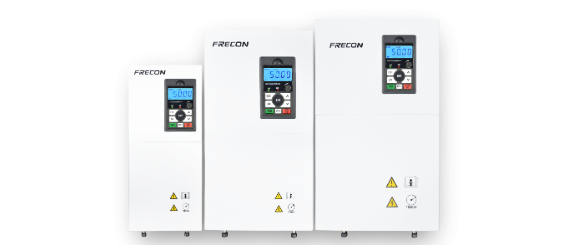
These space considerations influence how industrial drive manufacturers develop their products. FRECON offers the FR20 Series General Vector Inverter, which combines several electrical functions within one drive configuration.
The FR20 Series includes a built-in DC reactor, a standard C3 filter, and a built-in brake unit. It also features a built-in STO function. These integrated elements may reduce the need for certain external devices, depending on application requirements.
The drive supports a common DC bus solution and a parameter copy keyboard. The common DC bus capability provides another configuration option for suitable multi-drive applications. Parameter copying can simplify setup when technicians configure multiple units.
Its independent air duct design and support for through-wall installation are also relevant to cabinet planning. These features give engineers additional options for arranging equipment and managing cooling requirements.
Through-Wall Mounting Changes the Cabinet Layout
Mounting methods influence how much internal space a drive occupies. Conventional installations place the drive inside the cabinet, where its housing and required ventilation clearances contribute to the overall layout.
Through-wall installation offers an alternative arrangement. Part of the drive can extend through a suitable cabinet opening, allowing engineers to reconsider internal equipment placement. The actual space benefit depends on the mounting dimensions and surrounding components.
This approach can be useful when a compact inverter must operate alongside other electrical devices. Engineers should examine mounting drawings, cabinet wall construction, and installation clearances before selecting this arrangement.
Environmental protection also requires attention. Cabinet openings must be properly designed to maintain the required protection level. Dust exposure, sealing arrangements, and access for maintenance should be reviewed during mechanical design.
Cooling Design and Electrical Layout
Heat management becomes more important as cabinet dimensions decrease. Motor drives generate heat during operation, and inadequate airflow can increase internal temperatures. Engineers must evaluate the combined heat output of installed equipment.
An independent air duct design can support a more defined cooling path. However, cabinet ventilation still depends on mounting conditions, ambient temperature, and the airflow requirements specified for the equipment.
Cable routing presents another challenge. Power and control cables need suitable separation and sufficient bending space. Crowded wiring channels can complicate installation and make future modifications difficult.
A practical layout should balance compact dimensions with electrical safety and service access. Engineers can use equipment drawings and thermal calculations to identify space limitations before cabinet production begins.
What Engineers Should Verify Before Selection
A variable frequency drive manufacturer can provide product information that supports enclosure planning, but engineers must assess the complete installation. Drive dimensions, mounting clearances, integrated components, and cooling arrangements should be compared together.
For projects considering a general-purpose inverter, the electrical requirements remain central. Motor ratings, braking demands, control functions, and electromagnetic compatibility conditions influence whether integrated features can replace external equipment.
FRECON provides the FR20 Series as an option for applications requiring integrated drive functions and flexible installation arrangements. Its features should be assessed against actual cabinet dimensions and operating requirements rather than assumed space savings.
Making Cabinet Space Work More Effectively
Smaller control cabinets result from coordinated equipment selection and layout planning. Integrated functions may reduce external components, while suitable mounting and cooling arrangements can improve the use of available space.
The practical goal is not simply to install a smaller drive. It is to develop a cabinet layout that accommodates electrical equipment, supports heat dissipation, and remains accessible for maintenance. These considerations provide a more reliable basis for evaluating enclosure space.